Tips for Drawing the Human Body
Drawing Anatomy for Beginners, Learning the Ins and Outs
When it comes to learning how to draw people successfully, knowing homo anatomy is primal. Jeff Mellem, creative person and author of How to Draw People , shares the acme dos and don'ts of drawing anatomy for beginner artists so you tin start drawing more realistic figures in no time.
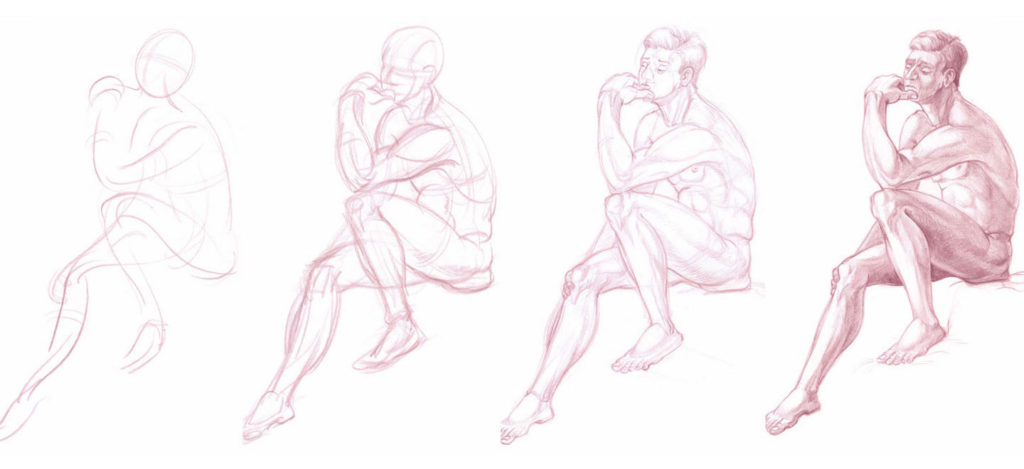
Figure Drawings excerpted from "How to Draw People" by Jeff Mellem
Learning to Draw? Check Out Our Live Video Series, Cartoon Together!
Learn to depict people, body parts, and much more in our alive weekly video series.
- How to Describe an Arm
- How to Draw a Skull
- How to Draw a Foot
- How to Draw a Mitt
1. DON'T think similar an anatomy book
Drawing anatomy for beginners can feel overwhelming at first because at that place are so many muscles on the body. When you lot're looking at a model and you lot come across a lot on bumps, yous might be tempted to pull out an anatomy volume to decipher what's going on under the pare.
An anatomy book is not bad at telling you what you're looking at but it's not very helpful at telling yous the three-dimensional shape of the muscles.
Do think in simple volumes
When you first approach figure drawing, yous need to showtime out with establishing the bones volumes of the figure using spheres, boxes, and cylinders. Past simply beginning with these bones shapes and and then building up the complication as y'all go forth, y'all will be able to brand your drawing maintain its sense of dimension.
If y'all re-create contours before you build in the construction, I guarantee you'll cease upward with a flat-looking cartoon.
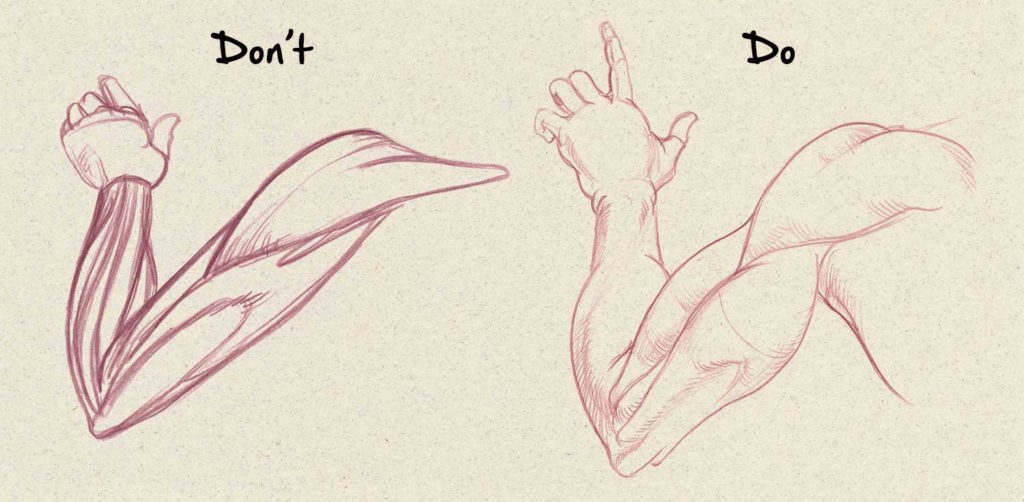
The drawing on the left overemphasizes the model's muscles and information technology looks more similar an anatomy book than a figure. An artist needs to recollect about the 3D shape of the muscles to give the figure an illusion of volume.
The Takeaway:
Employ an anatomy book to understand what's below the surface but think about each musculus in 3D. Don't draw the muscles as a serial of lines. Draw them every bit sculpted spheres, boxes and cylinders.
With that existence said, you don't always have to actually draw spheres and boxes on the page. If y'all wait at an artist like Harry Carmean, you can encounter that while he sometimes is only cartoon counters of the torso, he is conspicuously thinking virtually the 3D qualities of what he'due south cartoon.
2. DON'T make muscles the focus
When artists offset kickoff paying closer attention to calculation anatomy to their drawings, they frequently accept a tendency to overemphasize the beefcake. The figures often end up looking like they have no skin. The muscles are at that place to add more realism to the figure, simply they shouldn't be the focal point of the cartoon.
Exercise use muscles to reinforce the action
The focus of a drawing should convey an action, an emotion or the subject's personality. You lot don't desire a viewer to stop and look at the parts of your drawing; yous want the viewer to see the whole effigy and be interested in what that figure is doing and who he or she is.
In order to maintain focus on the action it's always a great practice to beginning all your drawings with a gesture drawing. A gesture drawing serves as a blueprint for the action. Everything that comes after is to help clarify and enhance that action.
The muscles should be drawn to dilate the movement of the figure and shouldn't describe attention to themselves. A skilful example of this is comic book characters that have exaggerated anatomy to convey their forcefulness.
A successful comic book page isn't about the character's muscles just about how that grapheme'due south power is being expressed in the story. The volumes of the muscles are designed to lead the centre through the body toward a point of activity. The reader isn't stopping to look at the character's well-developed musculature.
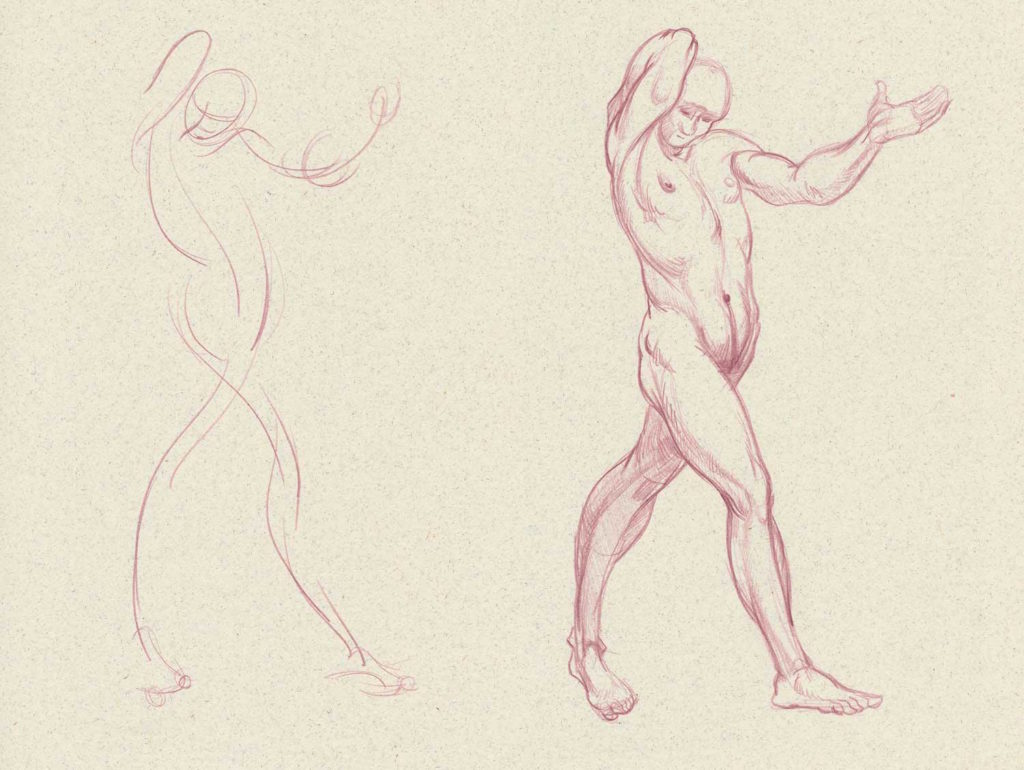
Notice how the muscles in the effigy on the correct reverberate the gesture drawing on the left. The muscles are used to reinforce the effigy's activeness, they aren't the focus of the drawing.
The Takeaway:
Anatomy is there to add realism only it's less important then conveying the activity and attitude of the whole figure.
3. DON'T draw every effigy with the same shapes
When artists kickoff using basic shapes to develop figures they often start to fall into a pattern of using the aforementioned shapes to build every figure.
Do observe and adapt to your effigy's unique build
When you're building your figure y'all have to wait and adjust your shapes to the specific field of study you're drawing. You lot're not going to utilize the same shapes for a bodybuilder that you would a sumo wrestler or a long distance runner.
Yous have to look at your subject and figure out what simple shapes are the best tools to develop your figure. For example, some people accept very squarish heads which needs to be constructed from box shapes while others have a more than roundish advent that should be built from spheres.
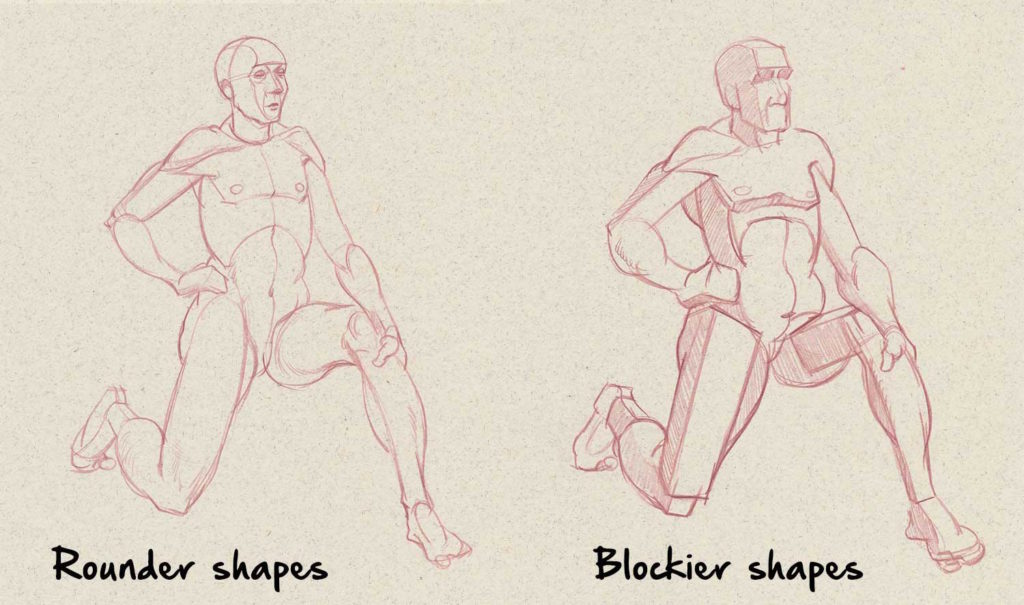
These two figures are in the aforementioned pose simply are built from different shapes. The figure on the right is built from more cake shapes and it gives the figure a sturdier feeling.
The Takeaway:
Don't arroyo every effigy with a formula. Instead, detect and adapt your shapes to fit your subject area.
4. DON'T copy what y'all come across
If yous only re-create what you see you will never create what you imagine. I never saw the point of replicating a photo in a drawing beyond being an exercise to build observational skills. Why indistinguishable what already exists when you can interpret and adjust every bit you lot see fit?
DO recreate what y'all come across on the page
Observational skills are important but not just for copying what you see. Employ your observational skills to analyze your subject'south unique shapes so you tin can reinterpret it on the page. That means you aren't copying counters of the body. Instead yous're recreating a figure on the page from the ground up.
Y'all get-go by capturing its motility in a gesture, rebuild the figure three-dimensionally using bones spheres, boxes and cylinders, and so sculpt those unproblematic shapes into anatomical forms. This is a very different process than just replicating what you lot meet.
You're combining what yous meet with your 3D knowledge of anatomy to recreate the figure on the page. This will not but aid yous to develop drawing that have a sense of mass but as well will allow y'all to adapt and change the figure to create something new.
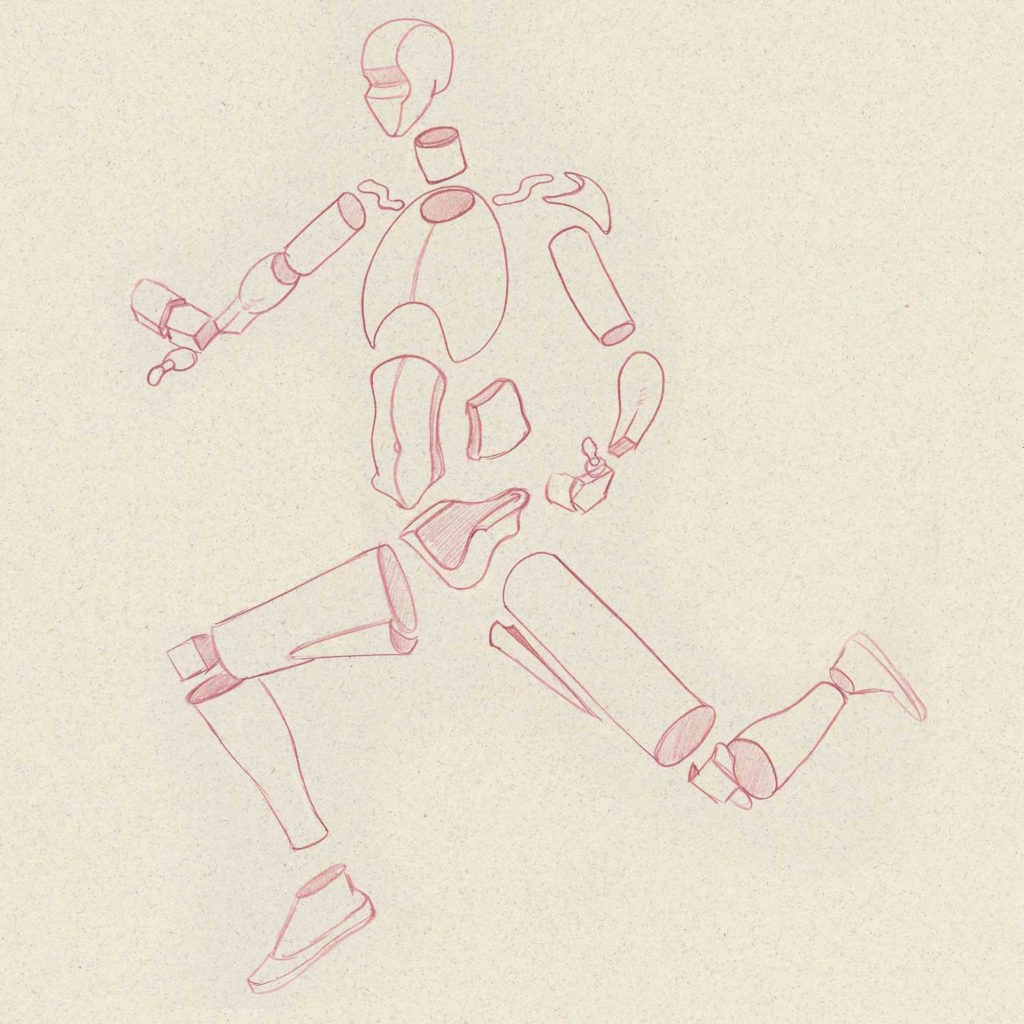
This is only a fun cartoon to help illustrate that y'all need to understand the 3D shapes of a figure and so you can reassemble them on the page. This is a unlike fashion of thinking than only copying the contours you lot see.
The Takeaway:
The task of an creative person isn't to replicate what he or she sees. It is to interpret what he or she understands. When cartoon a figure, you bring in your knowledge of anatomy and volume to draw a figure rather than just copying contours and values.
5. Exercise pay attention to proportions and anatomy
To draw a realistic figure, you lot need to pay attending to accurately capture the figure's proportions and anatomy. This comes from both studying anatomy and having good observational skills.
DON'T be overly rigid.
Anatomy and proportion are of import. But alone, they don't make for an interesting drawing. A figure drawing that feels like it has personality or appears dynamic is going to be more interesting than i that is technically right.
Let the anatomy and proportion take a supporting function to the underlying gesture cartoon. Every stride of your drawing should be to create a unified figure that has energy and attitude even if that means altering the figure's proportions or beefcake to better emphasize that action.
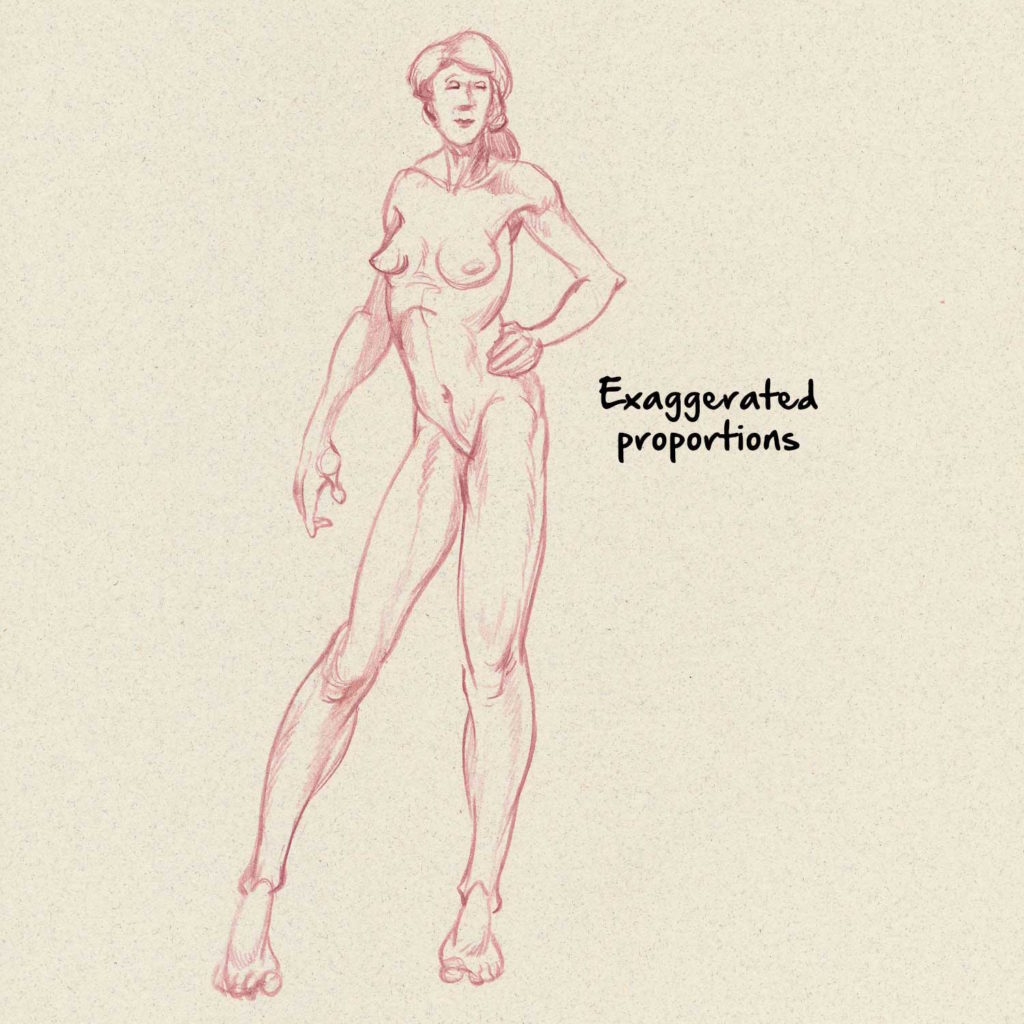
This figure has exaggerated proportions – similar to those used in fashion drawing. Information technology doesn't thing that it'south not correctly proportioned if the decision to exaggerate is purposeful. You can discover many examples of artists who distort and exaggerate proportions for stylistic reasons.
The Takeaway:
Drawing bang-up beefcake helps artists create realistic-looking figures that appear to accept actual mass and book. However, the beefcake needs to add to the sense of movement of the figure and not distract from information technology. Y'all must have the skill to be able to draw the muscles in 3D in order to modify and adapt the shapes and emphasize the motion and personality of your subjects.
More Resources on Drawing Beefcake and Figures
- 3 Mistakes You Brand When Cartoon the Figures
- Figure Cartoon Methods of the Masters
- Drawing Dynamic Human Figures
- Railroad train Your Center With Figure Sketching
- 5 Effigy Drawing Tips
Source: https://www.artistsnetwork.com/art-techniques/beginner-artist/drawing-anatomy-for-beginners/
0 Response to "Tips for Drawing the Human Body"
Post a Comment